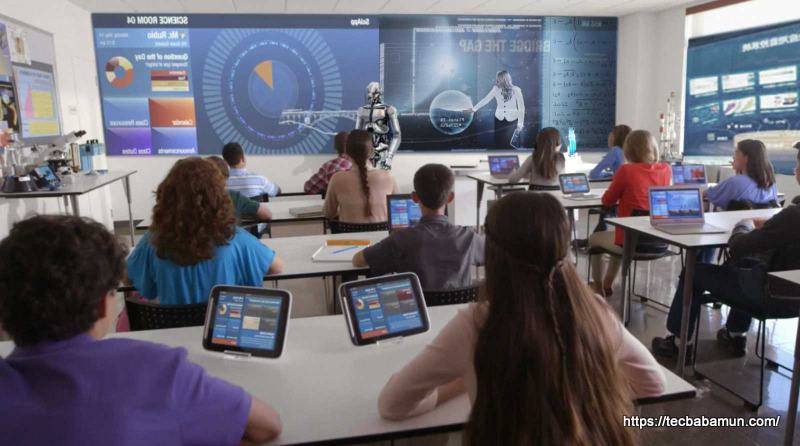
What Is Educational Technology?
The sole goal of Trend Educational Technology is to adopt new technologies or digital tools in the classroom and improve the distance learning experience.
Educational technology can be used by teachers to present knowledge in a way that is more beneficial for retaining learning concepts. The learning experience has made traditional teaching methods more engaging.
We have seen various new emerging trends including educational technology, cloud technology, blockchain technology, IOT, artificial intelligence and machine learning.
Technology is making this learning experience more enjoyable for professors, whose job it is to grade and assist individuals.
Collaborative Learning
The trend of educational technology innovation has made it possible for everyone to stay connected. The impact of information and the current trend of technology in educational communication have opened up multiple options.
We collaboratively connect, discuss, and work to solve situations. This has also been important in the collaborative approach to learning. Teachers encourage collaboration by setting group activities, classroom learning models, and tasks.
When students work together on a project or solve a problem, their collaborative skills improve. Working together increases engagement and increases their understanding.
Although e-learning is quite famous, sharing and discussion is still possible through collaboration.
The teacher enters the classroom. In the traditional teaching method, “you talk for about 30 minutes and leave when the bell rings.” Today, with the help of technology, the gap between students and teachers has narrowed.
Communication between teachers and students will be more frequent. Teachers now act as mentors and are much more available to help students develop.
This collaborative learning method helps students develop interpersonal skills and interact with their peers.
Unconventional Platforms
Can TikTok provide a platform of educational value? Of course. The landscape is evolving rapidly. Educational technology is moving beyond traditional online learning tools to include platforms like TikTok, Audible, Instagram, and YouTube.
As digital natives increasingly explore these unconventional sources to meet their educational needs, ed-tech innovators must create new ones.
Education through solutions that engage their audience and provide entertaining and new formats. Teaching Generation Z and beyond is an educational technology trend that you should definitely keep in mind if you are planning.
Immersive Environments
The use of immersive trend technologies such as augmented reality, mixed reality, and virtual reality in the classroom is expected to increase in 2024, as new high-profile devices integrating these realities are coming to market.
The possibilities for educational experiences now extend beyond wearing a headset and living in a remote location. With new technology, using just a cell phone or inexpensive camera, students can create their own local interactive 360-degree scenarios and simple online tools.
“This is an area that is really going to explode in the next few years,” Kristen Pilner Blair.
Research Director for the Digital Learning Initiative at the Stanford Accelerator for Learning,
which conducts a virtual field trip to promote learning programs to explore the use.
“For example, students can learn about the effects of climate change by virtually experiencing its impact on a specific environment. But they can also be creators, sharing and documenting immersive media to show its impact where they live.”
Integrating AI into virtual simulations could soon take the experience to another level, Schwarz said. “If your VR experience takes me to a redwood tree, you could pop up a window where I can ask questions about the tree and the AI can answer.”
Microlearning and Nanolearning
Small-sized learning modules have gained popularity due to their ability to meet short attention spans and busy schedules.
To focus content that is particularly appealing to Generation Z, microlearning emphasizes short topics, which are known for consuming short, engaging content.
Highlights of this Trend Include:
Duolingo breaks down complex topics into easily digestible chunks. The platform now has 74 million monthly active users and over 20 million people use it every day.
Integration of edutainment—blending education with interactive games, virtual adventures, and storytelling.
.
First Education is a mobile-friendly environment, accessible learning, and education that supports self-paced learning.
By providing engagement and flexibility, education seamlessly incorporates microlearning into trend lifestyles.
Teaching And Learning Process
First, ed-tech allows teachers to teach both online and offline. Instead of always having to go to a specific class at a specific time, students can learn wherever and whenever they are.
Second, ed-tech changes the way students learn. Ed-tech makes learning exciting and more fun for students. When we apply knowledge better in real life, we feel engaged in learning, remember better, and we learn better.
Ultimately, technology makes education smarter, more effective, and more responsive to student needs. Real teachers bring valuable knowledge to students, both in theory and practice.
But smart teachers are those who can tailor teaching to what students want to learn.
In short, EdTech does not mean that teachers have to be IT experts. But it is true that teachers can do these interesting tasks only with the help of technology, and that is why we need EdTech in our lives.
Video-Assisted learning
In recent years, video-assisted learning has become increasingly popular through classroom demonstrations. “Video Day” is no longer just about bringing televisions into the classroom on a trolley.
With digital devices and the internet, every day can be “video day.” Creative learning solutions have now become a trend in many forms.
This trend in educational technology is also growing in distance learning environments, where students learn through computer screens.
Animated videos, in particular, are extremely effective in enriching lessons and making content understandable. This improves student outcomes and reduces teachers’ workload.
Expansion of Microdentials and Digital Badges
Next on our list of emerging ed-tech trend are digital badges and microcredits. These online certifications are gaining popularity as an alternative way to validate skills and knowledge and for recognition. And they give students the opportunity to showcase their achievements in a more dynamic way.
The more companies and educational institutions adopt these qualifications, the more flexible learning paths students will be able to pursue that better align with their career goals.
Rise of Educational Communities
Higher education is another big trend in society, the future. Learning can be difficult, especially when it’s something people are usually used to doing in a somewhat isolated way.
However, learning communities are growing, and being a part of them is a huge saving grace! Learning communities provide entry points to students from diverse backgrounds in a variety of fields.
Such programs help incoming students transform through personalized courses, mentoring, and activities that build a community from within.
Learning communities are important because you can have camaraderie and evidence that other people are going through the same problems or struggles. And then what’s really important is that they help and encourage each other so they can achieve that degree.
eBooks and Digital Resources
Educational trends have also shifted significantly towards digital resources. Traditional textbooks are being replaced by e-books, and this shift has several benefits.
E-books are more portable and often cheaper. They can be easily updated, so students have access to the latest information.
Digital resources are not limited to e-books. Interactive maps, online simulations, and educational videos are readily available. These resources make the learning experience more immersive and engaging.
Dynamic Learning with Digital Twins
Virtual Replica Imagine having something in your hands: a factory, a jet engine, even an entire city. Wouldn’t it be great to experiment and learn without the real-world consequences of making mistakes?
Digital twins make this possible. It is one of the latest trends in educational technology controlled environments, allowing for hands-on exploration in a safe space.
Replicates and recreates real-world features through real-time data and advanced technology solutions.
Companies like BMW digitally simulate factory workflows, creating single machines that reduce errors earlier.
Hospitals are even practicing surgeries in a risk-free virtual environment and creating digital twins of organs to personalize treatment.
Singapore cities prefer to plan urban development, improve sustainability, and optimize traffic.
While students create custom models through research on autonomous vehicle technology, these virtual models mimic physical environments, making them particularly useful for projects like the Self-Driving Car Studio.
Partnerships and Mergers
EdTech companies are well-suited to developing new technologies in the education sector, while educational institutions incorporate them when creating impactful and informative educational content.
Over the past few years, educational institutions and ed-tech companies have been partnering to achieve growth, global reach, and innovation.
This trend could lead to more integrated educational solutions and comprehensive developments, providing students and teachers with a seamless and personalized learning experience.
Blockchain for Education
Blockchain technology has emerged as a promising, innovative, transparent, and secure academic record-keeping method.
This not only ensures the integrity of academic qualifications but also opens the door to a lifelong student record, enabling individuals to maintain a comprehensive and secure educational history.
Blockchain helps create micro-credentials, which allow students to demonstrate specific skills and abilities to potential employers and other educational institutions.
A digital revolution is taking place in education through blockchain-based credentialing platforms, smart contracts, and digital wallets. Universities can now securely store and distribute course materials, creating a more efficient and student-centric environment.
Education is in its infancy, but its potential is undeniable, having been adopted by blockchain in 2009. Blockchain stands as a beacon of innovation in education as we move towards a future of secure, efficient, and student-centric systems.
Conclusion
Of course, these are not all educational technology trends. However, these current educational trends indicate the direction of technology development.
Education is becoming increasingly accessible. Hands-on learning is gaining significant attention, and at the same time, technologies that facilitate its implementation are also improving.
All of these great educational technology tools make lifelong learning possible—where everyone continues to learn new things and improve their skills throughout their lives.
We just need to understand how we can leverage these tools to create more opportunities for continuous learning.